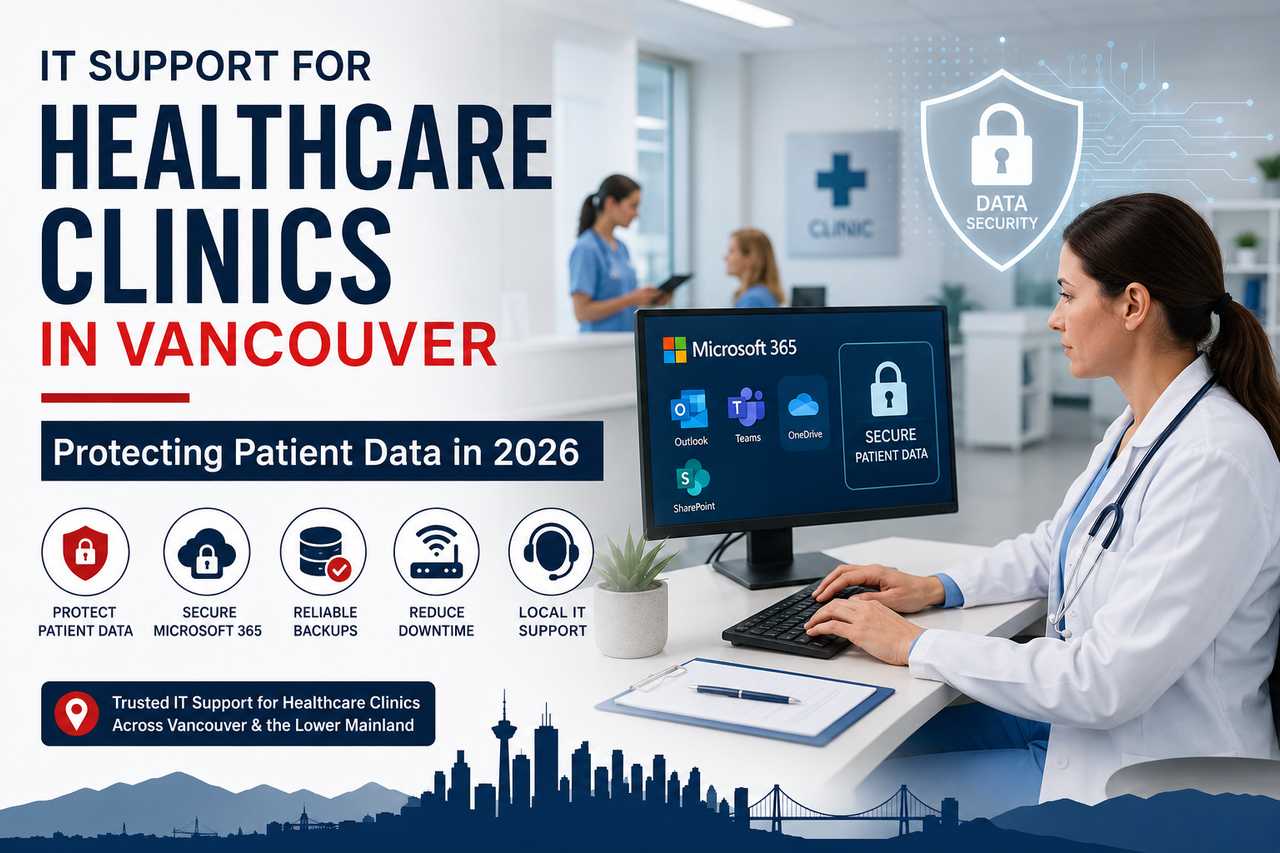


Lower Mainland SMBs: Reduce Ransomware Risk in 30 Days (2026)

In 2026, it’s not “big companies” getting targeted in Vancouver—it’s the law office in Burnaby, the construction firm in Surrey, and the clinic in Richmond. Industry reporting across 2024–2026 continues to show phishing as the top initial access method, and ransomware operators now move from first click to data theft in under 24 hours in many incidents.
If you’re running a mid-market or SMB environment in the Lower Mainland, you don’t need more security buzzwords—you need a practical set of moves that measurably reduces risk while keeping your team productive. Here’s a 2026-ready playbook you can actually implement.
1) Assume email is the breach path (and lock it down)
Most Vancouver organizations still treat email security as “spam filtering.” That’s not enough anymore. Business Email Compromise (BEC) and credential phishing are tuned to your real workflows: vendor invoice changes, payroll updates, SharePoint “document shared” prompts, or a fake Microsoft 365 sign-in page.
Start with controls that reduce the chance a single click becomes a full compromise. Your priority is to make stolen credentials useless and suspicious mail easier to spot—without creating constant friction.
What to implement in the next 30 days
- Phishing-resistant MFA for admins and executives (at minimum), plus conditional access rules for risky logins.
- Disable legacy authentication and enforce modern authentication for Microsoft 365.
- Implement DMARC with enforcement (not just monitoring) to reduce domain spoofing.
- Run a monthly phishing simulation and short, role-based training (finance, HR, operations).
If you’re on Microsoft 365, hardening identity and email is usually the fastest risk reduction per dollar. If you need help tuning policies without breaking work, see Microsoft 365 support options.
2) Treat ransomware as a business interruption problem
Ransomware isn’t only an “encryption” event anymore. The more common 2025–2026 pattern is: break in, steal data, then extort—sometimes without deploying encryption at all. That changes how you plan. You’re not just restoring files; you’re managing operations, legal exposure, and customer trust.
For many BC SMBs, the biggest gap is recovery readiness. You don’t know your real recovery time until you’ve tested it. Aim for a plan that keeps your core functions running even if a server, cloud tenant, or endpoint fleet is compromised.
Baseline targets that work for SMBs
- RTO in 4–8 hours for critical services (file shares, line-of-business apps, email access).
- Immutable backups (or write-once snapshots) plus an offline copy.
- Quarterly restore tests for the systems that would stop your business.
- Documented incident runbook: who decides, who contacts insurers, who talks to customers.
Pair this with endpoint detection and response (EDR) and a monitored alerting process. If you’re building a full program, start at cybersecurity services and work backward from your actual business impact.
3) Zero Trust isn’t a product—start with access boundaries
“Zero Trust” gets overused, but the principle is simple: don’t automatically trust anything just because it’s on your network. For Vancouver-area businesses with hybrid work (and lots of subcontractors in construction, logistics, and professional services), you need tighter access boundaries that still support fast onboarding.
The practical version is controlling who can access what, from where, and on what device—then logging it. When you do this well, lateral movement becomes harder, and the blast radius of a compromised account shrinks dramatically.
High-impact changes that don’t require a rebuild
- Least-privilege access: remove local admin rights from day-to-day users and use just-in-time elevation.
- Segment critical systems (accounting, payroll, EMR/PHI systems) away from general user networks.
- Device compliance checks for remote access (patched OS, disk encryption, screen lock).
- Separate admin accounts from user accounts; protect admins with stronger MFA and tighter policies.
Many teams can do 70% of this with better identity controls plus network segmentation. If you’re unsure where to start, a structured review of your environment and access paths is the fastest way to prioritize.
4) Make compliance practical: PIPEDA, CCCS, and real evidence
Compliance in Canada isn’t just paperwork—done right, it’s a checklist that forces stronger security habits. For businesses handling personal information, PIPEDA expectations around safeguards, breach response, and accountability matter. If you sell to larger organizations (or government-adjacent), you’ll also run into Canada’s security guidance ecosystem—think CCCS publications and, in more mature environments, alignment to ITSG-33 concepts.
The common failure point isn’t intent; it’s evidence. You may be “doing security,” but can you prove it quickly when an insurer, customer, or regulator asks?
Evidence you should be able to produce on demand
- Current asset inventory (devices, users, cloud services) and who owns each system.
- Access reviews for sensitive systems (quarterly is a realistic SMB cadence).
- Patch reporting: critical patches applied within 14 days (or a documented exception process).
- Security logs retained for at least 90 days (longer if your risk profile requires it).
If you’re preparing for customer security questionnaires or tightening privacy posture, you’ll get more value from a simple, repeatable framework than from one-off audits. See compliance support for building something sustainable.
5) Use AI carefully: secure your data before you “enable Copilot”
By 2026, AI assistants are baked into workflows—Microsoft Copilot, document summarizers, meeting transcription, and customer support tooling. The risk isn’t that AI is “evil.” The risk is that your permissions, sharing links, and data lifecycle rules were already messy—and AI makes discovery instant.
If someone can search it, an AI tool can surface it. That includes old HR folders, exposed proposal templates, and client documents living in the wrong Team or SharePoint site. The win is huge when it’s set up properly; the spill risk is also real.
Before expanding AI access, do these basics
- Data classification and clear rules for client confidential vs internal vs public.
- Review SharePoint and Teams external sharing and guest access.
- Enable sensitivity labels / retention where appropriate for regulated data.
- Centralize offboarding so accounts, tokens, and shared links get shut down reliably.
AI readiness is mostly identity and data governance. If you lock those down first, you can adopt AI faster with fewer surprises.
6) Operationalize security: monitoring, SLAs, and a human on call
Tools don’t respond to incidents—people do. A lot of SMB security programs fail because alerts go to an inbox no one watches, or because responsibilities are unclear when something looks wrong at 2:00 a.m. If you want security outcomes, you need operating rhythm: triage, escalation, containment, and lessons learned.
A realistic 2026 model for Vancouver SMBs is a hybrid: automated detection plus a defined response process and measurable service levels. That means you know what happens when suspicious sign-ins appear, when an endpoint starts beaconing, or when a user reports a payroll scam.
What “operational” looks like
- 15-minute acknowledgement for critical security alerts during business hours, with defined after-hours escalation.
- Documented incident severity levels and who approves containment actions.
- Monthly security review: top alerts, risky users, patch gaps, and backup status.
- Tabletop exercise twice a year (ransomware + BEC scenarios are the highest ROI).
If you want a clear, prioritized plan (not a 60-page report), book a cybersecurity assessment. If you’re ready to hand off day-to-day execution, talk to us through /contact-us and we’ll map the fastest path to lowering risk without slowing your team down.