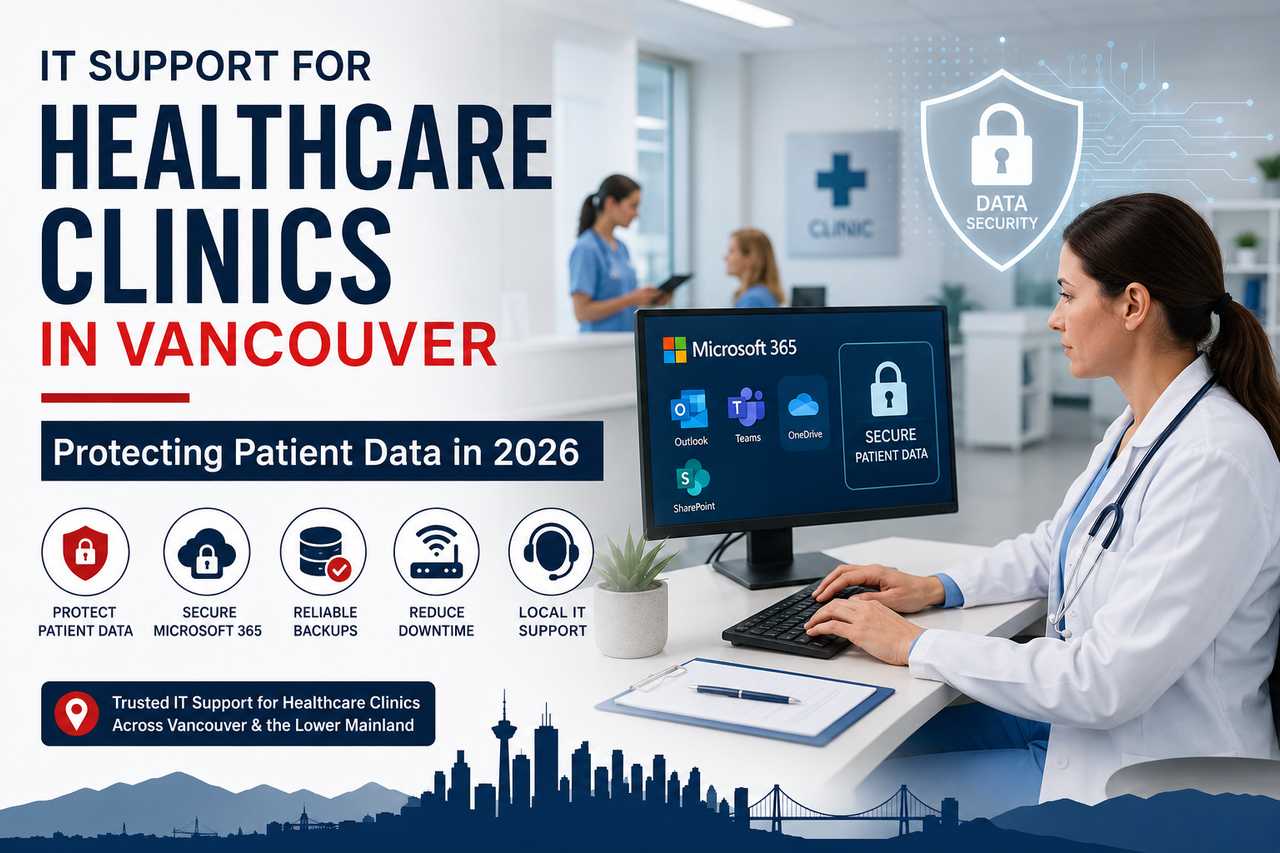


Vancouver Cybersecurity in 2026: 6 Controls to Cut Risk

A Monday morning in Vancouver: one “DocuSign” email lands in Accounts Payable, credentials get captured, and by lunch your Microsoft 365 tenant is sending spam and your finance team can’t access SharePoint. That’s not a rare story in 2026—Canadian SMBs are seeing more identity-first attacks than “Hollywood” hacking.
If you want cybersecurity that actually holds up in the Lower Mainland—construction firms in Burnaby, clinics in Surrey, logistics in Richmond, or SaaS teams downtown—your plan needs to focus on the controls that stop real incidents, not a binder of policies no one follows.
Why Vancouver businesses are targeted (and what’s changed in 2026)
Vancouver companies sit in a high-value intersection: cross-border trade, remote/hybrid work, and heavy SaaS adoption. Attackers don’t care if you’re a 25-person manufacturer in Coquitlam or a 200-seat professional services firm in Kits—they care that you have payroll data, client files, and payment flows.
What’s changed over the last couple years is the efficiency of fraud. In 2025–2026, phishing kits and AI-written lures made it easier to target your team with emails that look local (think: “BC Hydro billing update” or “Port of Vancouver shipment documents”). The Canadian Centre for Cyber Security has continued warning that ransomware and business email compromise remain top threats for Canadian organizations, and industry reporting in 2024–2026 shows most breaches still trace back to compromised credentials.
The business impact is usually not “all data leaked instantly.” It’s more practical and painful: mailbox rules that redirect invoices, SharePoint permissions quietly changed, or backups that don’t restore when you need them. The goal is to prevent the incident—or limit blast radius so you’re back in hours, not days.
The 6 controls that reduce risk fast (without enterprise bloat)
You don’t need 60 tools. You need the right foundation—implemented, monitored, and tested. These six controls are where we see the biggest security lift for Vancouver SMBs.
- Phishing-resistant MFA for Microsoft 365, VPN, and admin tools (plus blocking legacy authentication).
- Least-privilege access with separate admin accounts and just-in-time elevation.
- Endpoint protection + hardening (EDR, patching, disk encryption, application control where practical).
- Email security with SPF/DKIM/DMARC and stronger anti-impersonation controls for finance and executives.
- Immutable, tested backups that can restore both data and identity (M365 + servers + key SaaS data).
- Central logging + response playbooks so suspicious activity is detected and acted on quickly.
Done well, these controls cut off the most common entry paths: stolen passwords, unpatched endpoints, and inbox-based fraud. They also align cleanly with Canadian guidance (CCCS best practices) and map to security frameworks many insurers and auditors expect (for example, controls consistent with ITSG-33 concepts).
What “managed cybersecurity” should look like for an SMB in BC
Buying security tools isn’t the same as running security. For most mid-market teams, the win comes from operational discipline: clear ownership, consistent monitoring, and fast containment when something looks wrong.
Here’s what you should expect from a practical cybersecurity partner in Vancouver:
1) A risk review that produces an action list
Not a 70-page report. You want a prioritized backlog: what to fix this month, what to schedule this quarter, and what to accept as risk. A good baseline includes identity review (Microsoft 365, Entra ID), endpoint posture, email authentication, and backup/restore testing.
2) 24/7 alerting with real response
Security monitoring matters only if someone acts. A realistic SMB target is 15-minute triage for high-severity alerts and containment actions (disable sign-in, force password reset, isolate endpoint) within 60 minutes when confirmed. If a provider can’t define response time, you’re buying theatre.
3) Security that supports compliance (not just “checks boxes”)
Many BC businesses need to demonstrate due diligence under PIPEDA and customer contracts. You want evidence: MFA enforcement, audit logs, security training completion, patch reports, and incident records. If you operate in regulated spaces (health services, finance, public-sector vendors), this becomes non-negotiable.
If you need the broader foundation alongside security—asset management, patching, lifecycle planning—tie it to managed IT services so security isn’t bolted on as an afterthought.
Microsoft 365 is your security perimeter now—treat it that way
In the Lower Mainland, most SMBs run on Microsoft 365: Exchange Online, Teams, SharePoint, OneDrive. That’s convenient—and it’s exactly why attackers live there. Compromise one account, and they can search conversations, harvest invoices, and move laterally without touching your server room.
Strong M365 security usually comes down to a few moves you can validate quickly:
- Conditional Access (block risky sign-ins, restrict access by device compliance, reduce impossible travel risk).
- Privileged access controls (separate admin identities, reduce global admin count, enable just-in-time admin).
- Mailbox protections (anti-phishing policies, impersonation protection for executives/vendors, outbound spam controls).
- Data protection (basic sensitivity labels, external sharing rules, and retention where required).
Just as important: ensure you can restore. “We have OneDrive” is not a backup strategy. If a malicious actor encrypts files, deletes data, or you get hit with mass retention changes, you want a tested recovery plan.
For hands-on help securing and supporting your tenant, see Microsoft 365 support. If you want the broader security program view, start at cybersecurity services.
Costs, outcomes, and a simple 30-day plan you can execute
Cybersecurity should be measurable. For a typical Vancouver SMB (25–150 users), a sensible program aims to reduce avoidable incidents and shorten recovery time when something happens.
Benchmarks we commonly target for mid-market environments:
- 70–90% reduction in successful phishing sign-ins after enforcing MFA + Conditional Access + user training.
- Under 24 hours to restore critical services after a contained incident when backups are immutable and tested.
- 30–40% fewer help desk tickets tied to malware/pop-ups and account lockouts once devices are hardened and identity is cleaned up.
Here’s a practical 30-day rollout that doesn’t disrupt operations:
Week 1: Baseline and lock down identity
- Inventory accounts, admins, and shared mailboxes
- Enforce MFA everywhere and block legacy auth
- Turn on sign-in risk alerts and admin activity logging
Week 2: Secure endpoints
- Deploy/validate EDR on all devices
- Patch OS and third-party apps; remove unsupported software
- Confirm disk encryption and local admin controls
Week 3: Protect email and data
- Implement SPF/DKIM/DMARC and anti-impersonation rules
- Review external sharing and guest access
- Set minimum retention and recovery requirements
Week 4: Backups + incident readiness
- Validate backups for M365 and servers; run a restore test
- Create a one-page incident playbook (who decides, who contacts clients, what gets isolated)
- Run a 30-minute phishing tabletop with leadership and finance
Want this implemented with clear priorities and proof it’s working? Book a security review and get a remediation roadmap you can fund and execute. Start here: /cybersecurity-assessment or talk to our team at /contact-us.